

Yes, but schema isn't a ranking factor. It helps search engines understand who you are, what you offer and where, which supports sitelinks, Knowledge Panels and local visibility. Done badly, it can hurt you. For most businesses, connecting Organization, WebSite and WebPage matters more than chasing rich results.
If you read SEO discussions today, you will encounter two extremes. On one side, plugin vendors claim structured data is a direct ranking shortcut. On the other side, sceptics argue schema is useless because modern search engines already extract page content without code.
At Get First Position, we implement structured data weekly for home services, ecommerce stores, and local companies across Canada. The practical reality: is schema relevant to SEO in 2026? Yes, but not as an algorithmic ranking switch. Schema is an entity disambiguation layer. Executed properly, it connects your brand to search engine knowledge graphs. Executed carelessly, it creates intent conflicts, triggers validation errors, and wastes crawl budget.
The Short Answer: Schema Isn't a Ranking Factor (and That's Not the Point)
Let us settle the primary debate: is schema a ranking factor? No. Google has confirmed for years that structured data provides no direct ranking boost. If a page has thin content, slow load speeds, and weak authority, adding JSON-LD will not push it to page one.
Schema provides semantic disambiguation. It confirms facts and relationships that algorithms would otherwise infer. Treating schema as a direct ranking score misses its true commercial value: establishing trust, earning high-converting SERP enhancements, and anchoring your brand in Google's Knowledge Graph.
Why "Schema Is Useless" Gets It Half Right
The argument that "schema is useless" rests on a valid technical fact: Google's rendering systems and natural language models are exceptionally capable. If an HVAC contractor publishes a clean, server-rendered landing page titled "Furnace Repair in Burnaby" with visible contact details and clear pricing, Google understands the page without schema.
A fast, crawlable page with solid on-page SEO rarely needs schema for basic keyword matching. Where critics miss the mark is assuming basic indexing is the finish line. In competitive Canadian markets, the goal is dominating SERP real estate with expanded sitelinks, accurate Knowledge Panels, and verified local entity signals.
What Google Does Without Schema and Where It Guesses Wrong
Without schema, Google relies on heuristics and pattern recognition. While capable, algorithmic guessing often stumbles on multi-service or time-sensitive data.
For an HVAC contractor in Metro Vancouver, Google must guess:
- Whether a phone number connects to 24/7 emergency dispatch or sales.
- Whether "Burnaby" is a physical shop or one of ten regional service areas.
- Whether a promotional tune-up rate is currently active or expired.
- Whether the on-page brand matches listings on HomeStars, the BBB, and Google Maps.
Schema replaces probabilistic guessing with explicit, machine-readable facts.
What Schema Actually Does for Your Business in 2026?
If structured data does not directly push rankings higher, what does it accomplish? In 2026, schema markup for SEO drives four core commercial benefits.
Entity Understanding: Telling Google Who You Are
Search engines have shifted from indexing text strings to mapping interconnected entities—uniquely identifiable businesses, people, places, and services.
Structured data answers four essential questions:
- What is your legal and operating business name?
- What parent organization controls the domain?
- What specific services do you deliver, and across which exact geographic boundaries?
- Who are the verified professionals behind the business?
Building a connected entity graph prevents Google from confusing your brand with competitors and establishes the baseline trust needed for competitive local queries.
Sitelinks: The Most Underrated SERP Feature
Many marketers focus on review stars while ignoring search's most valuable visibility asset: expanded branded sitelinks.
When prospective clients search for your brand, an expanded sitelinks snippet commands dominant screen space on mobile and desktop. It pushes competitors down, displays direct shortcuts to high-margin service pages (like emergency heat pump repair), and substantially raises click-through rates.
Sitelinks cannot be enabled with a single tag; they are awarded when Google trusts your site hierarchy and entity architecture. A clean structure of WebSite, Organization, and WebPage schema with breadcrumbs provides the clarity Google requires to serve sitelinks.
Knowledge Panels and Local Visibility
For service businesses, the Google Knowledge Panel and Local 3-Pack generate high-intent phone calls. Google builds Knowledge Panels by reconciling data from your website, Google Business Profile, and third-party directories.
When on-page LocalBusiness schema matches external profiles—using identical Name, Address, Phone (NAP) and verified profiles (sameAs)—Google unifies these signals, strengthening local visibility across Vancouver, Surrey, and Burnaby.
Schema and AI Search: What Google Actually Says
With AI Overviews in Google Search and engines like ChatGPT and Perplexity, some claim special schema guarantees AI citations.
To be clear: Google has confirmed there is no proprietary "AI schema" for AI Overviews.
Agency Note: Structured data supports AI visibility by establishing factual entity consistency across search engines, not by unlocking an exclusive AI ranking channel.
Structured data aids AI search exactly like traditional search: by delivering clean, unambiguous facts. When an AI engine evaluates "emergency furnace repair in Burnaby," a site with valid HVACBusiness schema and explicit areaServed properties provides verifiable facts that AI models can reference reliably.
When Bad Schema Is Worse Than No Schema?
Because structured data is invisible to website visitors, many businesses deploy invalid or misleading markup that damages their search visibility.
The FAQ Schema Trap: How Chasing Rich Results Changes Your Search Intent
A frequent issue found during our technical SEO audits is adding FAQPage schema to commercial service pages.
Marketers previously added accordion FAQs to every sales page (such as "AC Installation in Surrey") chasing SERP accordions. This caused two problems:
- Search Intent Dilution: Adding lengthy informational Q&As to commercial landing pages signals informational rather than commercial intent, weakening pages meant for immediate bookings.
- Restricted Eligibility: In August 2023, Google limited FAQ rich results almost exclusively to government and health websites, while eliminating
HowTosnippets entirely.
Adding obsolete FAQ schema to commercial pages compromises your conversion layout for rich snippets Google no longer shows for local businesses.
Self-Serving Review Markup
Google's guidelines strictly prohibit star ratings for LocalBusiness and Organization schemas when reviews are hosted on the business's own domain.
Google disables review stars for self-serving local business markup to prevent manufactured ratings. Nesting reviews inside unrelated schema types (like Product) violates Google's policies and risks structured data penalties.
Marking Up Data That Isn't True or Isn't on the Page
Structured data rules require that all JSON-LD content must be visibly present to users on that exact page.
Common violations include declaring 24/7 hours when copy lists standard hours, including hidden prices, or listing dozens of cities in areaServed when the page covers one locality. Mismatches between structured data and visible text risk manual spam penalties.
The One Implementation Most Sites Get Wrong: The Entity Triangle
Most CMS plugins generate isolated JSON-LD blocks on each URL: a business block on the homepage, an article block on the blog, and unlinked service blocks on subpages. This creates disconnected fragments rather than a unified graph.
The recommended architectural model is the Entity Triangle: linking Organization (or LocalBusiness), WebSite, and WebPage using persistent @id URIs.
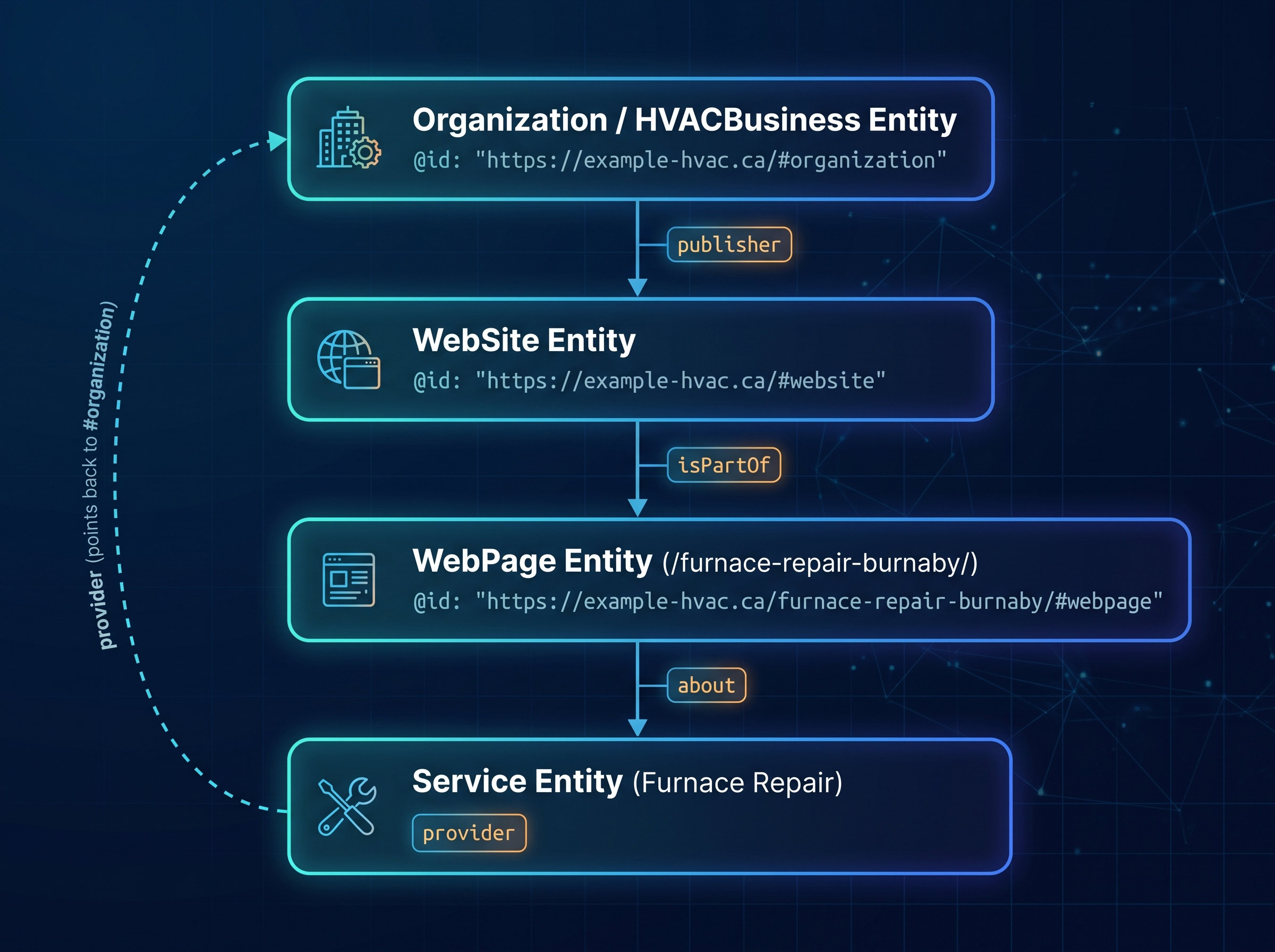
Organization (or LocalBusiness) + WebSite + WebPage
The Entity Triangle connects three core nodes:
- Organization Node (
#organization): Defines the legal business entity, contact details, physical address, and verified profile links. - WebSite Node (
#website): Defines the overall website, linking to the Organization as itspublisher. - WebPage Node (
#webpage): Defines the specific URL, declaring that it isisPartOfthe#websiteand connecting to specific offerings viaabout.
Connecting Them With @id So You Write It Once and Reuse It Everywhere
The @id property serves as a universal identifier. Rather than re-entering business details across every page, you define your master entity once and reference its @id across all subpages.
For a furnace repair page, the service provider points to {"@id": "https://example-hvac.ca/#organization"}. For blog articles, the author and publisher reference their respective @id nodes, confirming all pages belong to one verified business entity.
Real Example: Schema for an HVAC Company
Here is a production-ready schema implementation for a fictional company: Pacific Peak Heating & Cooling, based in Burnaby, BC, serving Metro Vancouver.
The HVACBusiness Entity
Schema.org provides a specific type for climate contractors: HVACBusiness (a subtype of LocalBusiness). Using HVACBusiness provides clear industry context.
Key properties include:
- Business name, URL, telephone, and contact email.
- Canadian postal address formatted with
BCprovince standards. - Exact
geocoordinates andopeningHoursSpecificationdetailing regular hours plus 24/7 emergency dispatch.
Service Pages: Service + areaServed (Not FAQPage)
On commercial service pages, we attach a Service entity to the WebPage using about:
serviceType: "HVAC Repair"provider: pointing tohttps://example-hvac.ca/#organizationareaServed: specifying "Burnaby"
This focuses search engines on commercial repair intent rather than informational content.
Seasonal Offers With an Expiry Date
HVAC companies frequently offer seasonal discounts (such as pre-winter furnace tune-ups). Using Offer within hasOfferCatalog, include validFrom and validThrough dates so search engines know exactly when promotional pricing expires.
Strengthening Your Entity With sameAs and subjectOf
We strengthen entity trust with two properties:
sameAs: References verified profiles (Google Business Profile, BBB, HomeStars, and manufacturer dealer locators like Lennox).subjectOf: References third-party publications writing about the business, such as local newspaper articles or municipal features.
Note: subjectOf is sound entity practice for connecting third-party press coverage to your entity graph.
The Complete JSON-LD Example
Below is the complete, valid JSON-LD graph for Pacific Peak Heating & Cooling:
{
  "@context": "https://schema.org",
  "@graph": [
    {
      "@type": "HVACBusiness",
      "@id": "https://example-hvac.ca/#organization",
      "name": "Pacific Peak Heating & Cooling",
      "url": "https://example-hvac.ca/",
      "logo": "https://example-hvac.ca/assets/images/logo.png",
      "image": "https://example-hvac.ca/assets/images/facility.jpg",
      "telephone": "+1-604-555-0198",
      "email": "service@example-hvac.ca",
      "priceRange": "$$",
      "address": {
        "@type": "PostalAddress",
        "streetAddress": "4500 Still Creek Drive",
        "addressLocality": "Burnaby",
        "addressRegion": "BC",
        "postalCode": "V5C 0E5",
        "addressCountry": "CA"
      },
      "geo": {
        "@type": "GeoCoordinates",
        "latitude": 49.2577,
        "longitude": -123.0076
      },
      "openingHoursSpecification": [
        {
          "@type": "OpeningHoursSpecification",
          "dayOfWeek": ["Monday", "Tuesday", "Wednesday", "Thursday", "Friday"],
          "opens": "08:00",
          "closes": "17:00"
        },
        {
          "@type": "OpeningHoursSpecification",
          "dayOfWeek": ["Monday", "Tuesday", "Wednesday", "Thursday", "Friday", "Saturday", "Sunday"],
          "opens": "00:00",
          "closes": "23:59",
          "description": "24/7 Emergency Heating & Cooling Dispatch"
        }
      ],
      "areaServed": [
        { "@type": "City", "name": "Vancouver" },
        { "@type": "City", "name": "Burnaby" },
        { "@type": "City", "name": "Surrey" },
        { "@type": "City", "name": "Richmond" },
        { "@type": "City", "name": "Coquitlam" }
      ],
      "sameAs": [
        "https://www.google.com/maps?cid=1234567890123456789",
        "https://homestars.com/companies/example-pacific-peak-hvac",
        "https://www.bbb.org/ca/bc/burnaby/profile/heating-and-air-conditioning/example-pacific-peak",
        "https://www.lennox.com/dealers/pacific-peak-hvac"
      ],
      "subjectOf": [
        {
          "@type": "NewsArticle",
          "headline": "Burnaby HVAC Contractor Leads Cold-Climate Heat Pump Transition",
          "url": "https://example-burnabynow.com/business/pacific-peak-heat-pumps-2026"
        }
      ]
    },
    {
      "@type": "WebSite",
      "@id": "https://example-hvac.ca/#website",
      "url": "https://example-hvac.ca/",
      "name": "Pacific Peak Heating & Cooling",
      "publisher": {
        "@id": "https://example-hvac.ca/#organization"
      }
    },
    {
      "@type": "WebPage",
      "@id": "https://example-hvac.ca/furnace-repair-burnaby/#webpage",
      "url": "https://example-hvac.ca/furnace-repair-burnaby/",
      "name": "Emergency Furnace Repair in Burnaby, BC | Pacific Peak",
      "description": "Fast 24/7 emergency furnace repair across Burnaby and Metro Vancouver. Certified technicians, upfront flat-rate pricing.",
      "isPartOf": {
        "@id": "https://example-hvac.ca/#website"
      },
      "about": {
        "@id": "https://example-hvac.ca/furnace-repair-burnaby/#service"
      }
    },
    {
      "@type": "Service",
      "@id": "https://example-hvac.ca/furnace-repair-burnaby/#service",
      "name": "Emergency Furnace Repair",
      "serviceType": "HVAC Repair",
      "provider": {
        "@id": "https://example-hvac.ca/#organization"
      },
      "areaServed": {
        "@type": "City",
        "name": "Burnaby"
      },
      "hasOfferCatalog": {
        "@type": "OfferCatalog",
        "name": "Heating Maintenance & Repair Services",
        "itemListElement": [
          {
            "@type": "Offer",
            "@id": "https://example-hvac.ca/furnace-repair-burnaby/#winter-tuneup-offer",
            "name": "Fall & Winter 21-Point Furnace Safety Tune-Up Special",
            "price": "129.00",
            "priceCurrency": "CAD",
            "availability": "https://schema.org/InStock",
            "validFrom": "2026-09-01",
            "validThrough": "2026-11-30",
            "seller": {
              "@id": "https://example-hvac.ca/#organization"
            }
          }
        ]
      }
    }
  ]
}
Graph Design Highlights
- Unified Identity: Company NAP and contact data are defined once under
#organization. - Connected Hierarchy: The
WebPagereferences#website, and theServicelinks to#organization. - Expiring Offers: The seasonal offer includes
validFromandvalidThroughdates to prevent indexing stale rates. - External Authority: Verified profiles (
sameAs,subjectOf) link the digital graph to trusted offline records.
Think in Page Types, Not Pages
Hardcoding unique JSON-LD for every individual page creates maintenance debt. Professional implementations design schema around standardized Page Types.
Required vs. Optional Properties for Each Page Type
Use this template blueprint across your website:
| Page Type | Schema Types | Always-Present Properties | Optional Enhancements |
|---|---|---|---|
| Homepage | HVACBusiness + WebSite |
name, url, logo, address, telephone, openingHoursSpecification, geo |
sameAs (profiles), subjectOf (press) |
| Core Service Page | WebPage + Service |
name, serviceType, provider (@id), areaServed, description |
hasOfferCatalog, offers, termsOfService |
| City / Area Page | WebPage + Service |
name, areaServed (City), provider (@id), serviceArea |
containedInPlace, local landmarks |
| Blog Guide | WebPage + Article |
headline, author (Person @id), publisher (@id), datePublished, dateModified, image |
about (topic), mentions (brands) |
| Seasonal Offer Page | WebPage + Offer |
name, price, priceCurrency (CAD), validFrom, validThrough, seller (@id) |
eligibleRegion, category |
| Technician Page | WebPage + Person |
name, jobTitle, worksFor (@id), image |
hasCredential (trade license, Red Seal) |
Planning for Missing Data (Error States)
Dynamic CMS templates frequently break when encountering missing fields. If a technician bio lacks a phone number or a service page has no set price, poorly built plugins often output empty strings ("price": ""), null values ("validThrough": null), or placeholder text ("telephone": "TBD").
These outputs create validation errors in Google Search Console.
The golden rule: if a data point is missing, omit the property entirely. Never output empty keys or null values. Always test templates against sparse entries, not just fully completed showcase pages.
Which Pages to Prioritize (and Which to Skip)?
When deploying structured data with limited development hours, prioritize pages by business risk and semantic ambiguity:
- High Priority: Time-Sensitive Offer & Rebate Pages. Pages with government incentives (like CleanBC heat pump grants) or seasonal discounts require
validThroughdates so search engines do not index expired offers. - High Priority: City and Service Area Pages. Multi-location service pages (e.g., Burnaby vs. Coquitlam furnace repair) often have similar copy. Distinct
areaServedproperties ensure search engines map each page to the correct local market. - High Priority: Core Revenue Service Pages. Primary services need explicit
Servicenodes connected to your parent business@id. - Low Priority: Static Utility Pages. "About Us," "Contact," and legal policy pages require only basic
WebPageschema referencing your masterWebSite. Avoid complex schema for standard utility templates.
How to Test Your Schema Before It Goes Live?
Never publish structured data updates without testing on staging. A syntax error (like a missing comma) will silently break the entire script block.
Follow this validation process:
- Syntax and Structure Check: Test your JSON-LD code in the Schema Markup Validator to verify compliance with Schema.org standards and confirm
@idlinks. - Google Feature Eligibility: Test rendered staging URLs in Google's Rich Results Test to ensure eligibility for search features.
- Site-Wide Crawl Audit: Run Screaming Frog with Structured Data Extraction enabled (Configuration > Spider > Extraction > JSON-LD) to audit thousands of pages for broken templates.
- Error State Testing: Test sparse pages to verify omitted fields do not render broken null values.
How to Measure Schema Without Fooling Yourself?
Avoid tracking isolated "Schema CTR" metrics. Google regularly tests search result layouts, font sizes, and rich snippet displays without warning. Fluctuations in rich snippet impressions usually reflect Google's UI testing rather than implementation issues.
Instead, evaluate meaningful entity performance signals:
- Indexation Speed and Accuracy: How quickly does Google index and correctly classify new service and location pages?
- Knowledge Panel Completeness: Does your desktop Knowledge Panel show accurate contact info, business hours, and verified profiles without data splits?
- Branded Sitelinks Footprint: Does your brand search result generate expanded sitelinks directing users to top service pages?
- Enhancement Health in Search Console: Are your template reports maintaining zero critical errors across indexed pages?
Need Help Getting Your Schema Right?
Deploying effective structured data requires more than installing an automated plugin. It requires a deliberate entity architecture that accurately reflects your business, reinforces local authority, and optimizes your site for organic and AI-assisted search.
At Get First Position, we engineer clean, connected schema architectures for Canadian service companies, regional businesses, and ecommerce stores. Whether you need a comprehensive SEO strategy, advanced local SEO services, or an in-depth technical SEO audit to resolve markup errors, our team has the technical expertise to help.
Contact Get First Position today to schedule a consultation and strengthen your search presence.